
AI Memory Apps: How Artificial Intelligence Is Changing Personal Memory Support
The term “AI memory app” means different things depending on who you ask. For developers, it refers to infrastructure that gives chatbots and AI agents the ability to remember past conversations. For consumers, it increasingly means apps that use AI to help people capture, organise, and recall information from daily life.
This article focuses on the second category: AI memory apps designed for personal use. If you have ever wished you could instantly find something you said in a meeting last week, or wanted an app that would remind you of important details without relying on your own recall, this is the space worth understanding.
What AI Actually Does in a Memory App
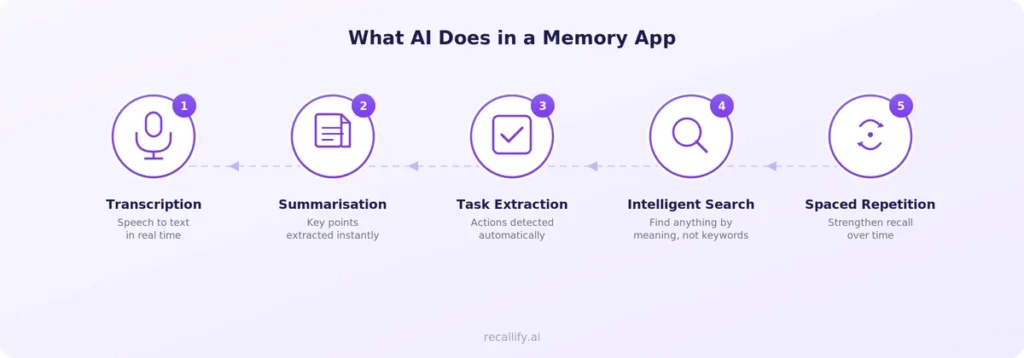
Most memory apps before AI were essentially note taking tools with search. You typed something, saved it, and hoped you could find it later. AI changes this in several practical ways.
Transcription. AI can convert speech to text in real time. This means you can record a conversation, lecture, or appointment and get a searchable transcript without typing anything. For people who struggle to take notes and listen at the same time, or who forget details from conversations, this is a fundamental shift.
Summarisation. Long recordings or notes can be condensed into key points automatically. Instead of re-listening to a 45 minute meeting, you get a clear summary highlighting decisions, dates, names, and action items. This reduces cognitive load and makes information accessible in seconds.
Task extraction. Some AI memory apps can identify tasks and action items from unstructured content. You say “I need to call the GP on Thursday” during a conversation, and the app detects it as a task, suggests a reminder, and offers to add it to your calendar. No manual entry required.
Intelligent search. Rather than searching by exact keywords, AI powered search lets you ask natural questions like “what did Sarah say about the deadline?” and get relevant results from your recordings and notes. This is closer to how human memory actually works: by association and context, not by filename.
Spaced repetition and active recall. Some AI memory apps generate quiz questions from your own content and schedule reviews at intervals designed to strengthen retention. This applies research backed techniques that have been shown to improve long term memory in both healthy adults and people with memory impairments.
Types of AI Memory Apps
Not all AI memory apps serve the same purpose. They broadly fall into three categories:
Developer and enterprise tools
Products like Mem0, Supermemory, and LangMem provide memory infrastructure for AI systems. They help developers build chatbots and AI agents that can remember user preferences and past interactions. These are not consumer apps. They are APIs and SDKs designed for software teams.
If you are searching for an AI memory app to help with your own daily life, these are not what you need.
Legacy and novelty memory apps
Apps like HereAfter AI and Personal AI focus on recording life stories or building a digital version of yourself. These serve a specific purpose (preserving memories for family, creating a personal AI persona) but they are not designed for practical daily memory support like remembering tasks, managing appointments, or organising information.
Personal AI memory support apps
This is the category that matters for most people searching for an AI memory app. These apps use AI to help you capture information as it happens, organise it without manual effort, and retrieve it when you need it.
Recallify falls into this category. It combines real time transcription, AI summarisation, automatic task extraction, intelligent search, and spaced repetition in a single app. It was developed by Dr Sarah Rudebeck, a Senior Clinical Neuropsychologist with a PhD in memory disorders from Oxford, and is designed specifically for people who need practical memory support, including those managing ADHD, acquired brain injury, mild cognitive impairment, and everyday forgetfulness.
Other apps in the broader AI productivity space, such as Otter.ai (meeting transcription) and Notion AI (note organisation with AI search), offer some of these features individually. Otter.ai is strong on transcription but does not offer task extraction, spaced repetition, or memory support features. Notion AI is powerful for knowledge management but requires significant manual setup and is not designed around cognitive support.
What to Look for in an AI Memory App
If you are evaluating AI memory apps for personal use, these are the features that make the biggest practical difference:
Voice capture with automatic transcription. The lower the friction at the point of capture, the more likely you are to use it consistently. An app that requires you to type defeats the purpose if the problem is forgetting things before you can write them down.
Automatic organisation. The app should categorise, summarise, and structure information without requiring you to create folders, tags, or categories manually. If organising your notes requires the same executive function as remembering the information in the first place, the tool is not solving the problem.
Contextual retrieval. Being able to search by meaning rather than exact keywords makes a significant difference. “What did the consultant say about my medication?” is a more natural query than trying to remember which file or recording contains that information.
Privacy and security. An AI memory app handles sensitive personal information: medical appointments, financial details, private conversations. Look for encrypted storage, transparent data handling, and the ability to delete your data. Recallify is GDPR compliant, ICO registered, and Cyber Essentials certified, with data encrypted both at rest and in transit.
Support for memory challenges. If you are looking for an AI memory app because of a specific condition, such as ADHD, brain injury, or cognitive fatigue, choose one that is designed with those challenges in mind. Generic productivity apps often assume consistent focus and reliable working memory, which is precisely what these conditions disrupt. Apps designed by clinicians with expertise in cognitive support are more likely to address the real barriers.
The Difference Between a Memory App and a Note Taking App
This distinction matters because many people searching for an AI memory app end up with a note taking app that has AI features bolted on.
A note taking app stores what you type. An AI memory app captures what happens around you (conversations, meetings, lectures, thoughts) and turns it into organised, searchable, actionable information without requiring you to do the organising.
The practical difference is significant. A note taking app helps if you can remember to write things down, organise them logically, and find them later. An AI memory app helps when you cannot do those things reliably, which is exactly the situation that leads people to search for memory support in the first place.
For students, this means recording a lecture and getting both a summary and revision quizzes automatically, rather than trying to take notes while listening. For professionals, it means capturing action items from a meeting without relying on memory or manual note taking. For people with memory challenges, it means having a reliable external system that reduces daily cognitive load.
Getting Started
If you are exploring AI memory apps, the most important step is identifying your specific need. Are you forgetting tasks? Losing track of conversations? Struggling to study effectively? The right app depends on the problem you are trying to solve.
For practical, everyday memory support that combines capture, organisation, and retrieval in one place, Recallify is designed exactly for this purpose. It is available on iOS and Android with a 7 day free trial.
For a broader comparison of memory apps including non AI options, or for specific needs like ADHD productivity tools or task management, our guides cover each area in detail.
Note: Recallify is designed as an everyday support tool and is not a medical device. It does not provide diagnosis or clinical decision support, and is intended to complement, not replace, professional medical care.
iOS App
Get Recallify from App Store today.

Android App
Get Recallify from Google Play today.

Frequently Asked Questions
What is an AI memory app?
An AI memory app uses artificial intelligence to help you capture, organise, and recall information from daily life. Unlike a simple note taking app, it can transcribe speech, summarise content, extract tasks, and let you search your memories by meaning rather than keywords. Some AI memory apps also use techniques like spaced repetition to strengthen long term retention.
What is the best AI memory app in 2026?
It depends on your needs. For practical daily memory support with transcription, summarisation, task extraction, and spaced repetition, Recallify is purpose built for this. For meeting transcription specifically, Otter.ai is a strong option. For knowledge management with AI search, Notion AI works well but requires more manual setup. For developer infrastructure, Mem0 and Supermemory serve a different purpose entirely.
Can an AI memory app help with ADHD or memory problems?
Yes. People with ADHD, acquired brain injury, mild cognitive impairment, and other conditions that affect memory often benefit from tools that reduce the reliance on working memory. An AI memory app that captures information automatically, organises it without manual effort, and provides timely reminders addresses the specific executive function challenges these conditions create. Recallify was designed by a clinical neuropsychologist specialising in memory disorders and is currently part of an NIHR funded feasibility study for brain injury self management.
Is my data safe in an AI memory app?
This varies by app. Look for encrypted storage (both at rest and in transit), GDPR compliance, and clear data deletion policies. Recallify is GDPR compliant, ICO registered, and Cyber Essentials certified. Your data is encrypted and you can delete it at any time.
How is an AI memory app different from a note taking app?
A note taking app stores what you type. An AI memory app captures what happens around you, including conversations, meetings, and thoughts, and turns it into organised, searchable information automatically. The key difference is that an AI memory app works even when you cannot remember to write things down or organise your notes manually.