
Active Recall and Spaced Repetition: The Evidence, How They Work, and How to Use Them
Active recall and spaced repetition are the two most effective learning techniques identified by cognitive science. Active recall is a learning technique where you test yourself on information rather than passively rereading it. Spaced repetition is the practice of reviewing that information at gradually increasing intervals over time. Together, they form the most effective combination for long term memory retention that cognitive science has identified.
This guide covers what both techniques are, the research evidence behind them, how they reduce cognitive load, and practical ways to apply them to studying, professional development, and everyday life.
The Testing Effect: How Active Recall Strengthens Memory
Active recall works because of a well documented phenomenon in cognitive psychology known as the testing effect. When you actively retrieve information from memory, rather than simply recognising it on a page, you strengthen the neural pathways associated with that knowledge.
The process is straightforward: instead of rereading your notes or highlighting text, you close your materials and try to recall the information from memory. This effort of retrieval is what makes the difference. Each successful recall strengthens the memory trace, making it easier to access next time. Even unsuccessful attempts at recall improve subsequent learning, because the effort itself signals to your brain that this information matters.
The testing effect has been studied extensively since the early 2000s and is now one of the most robust findings in learning science. It applies across ages, subject areas, and types of material, from vocabulary and factual knowledge to conceptual understanding and procedural skills.
The Forgetting Curve and Spaced Repetition
While active recall addresses how to engage with information, spaced repetition addresses when to review it.
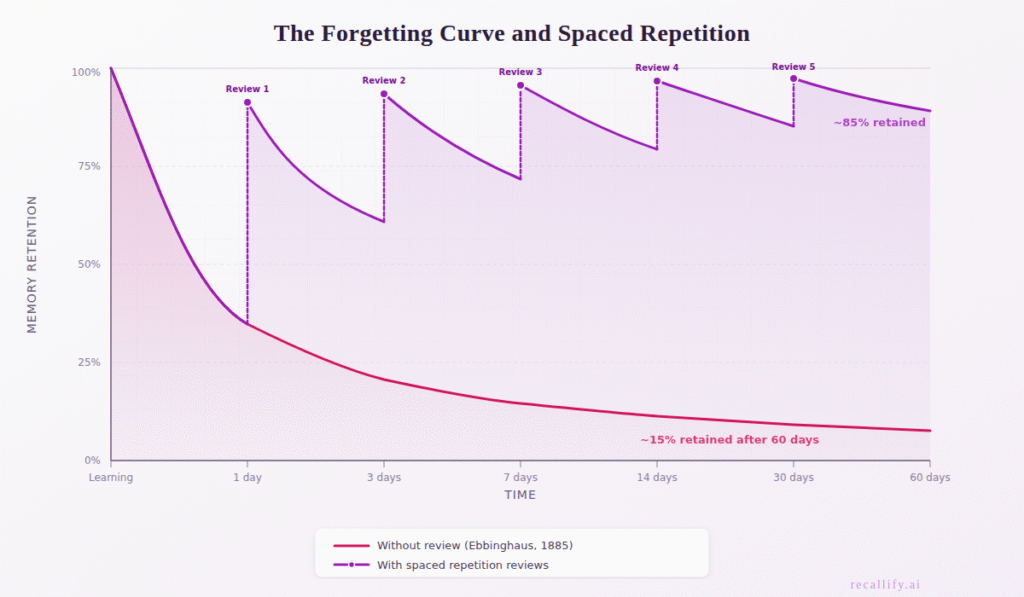
In the 1880s, the German psychologist Hermann Ebbinghaus conducted a series of experiments on his own memory, documenting how quickly newly learned information is forgotten. His results produced what is now called the forgetting curve: a steep decline in retention that begins almost immediately after learning. Without any review, most people forget roughly 50% of new information within an hour and up to 70% within 24 hours.
However, Ebbinghaus also discovered that each time you review the material, the forgetting curve flattens. The memory becomes more durable, and the intervals between necessary reviews grow longer. This is the principle behind spaced repetition: reviewing information at increasing intervals (for example, after 1 day, then 3 days, then 7 days, then 14 days) to maintain retention with the minimum amount of effort.
Modern spaced repetition systems calculate these intervals algorithmically, but the core principle is simple: review before you forget, and gradually extend the gap between reviews as the memory becomes more stable.
The Research Evidence for Active Recall and Spaced Repetition
The effectiveness of active recall and spaced repetition is supported by decades of research. Here are some of the key studies:
Roediger and Karpicke (2006): The Landmark Retrieval Practice Study
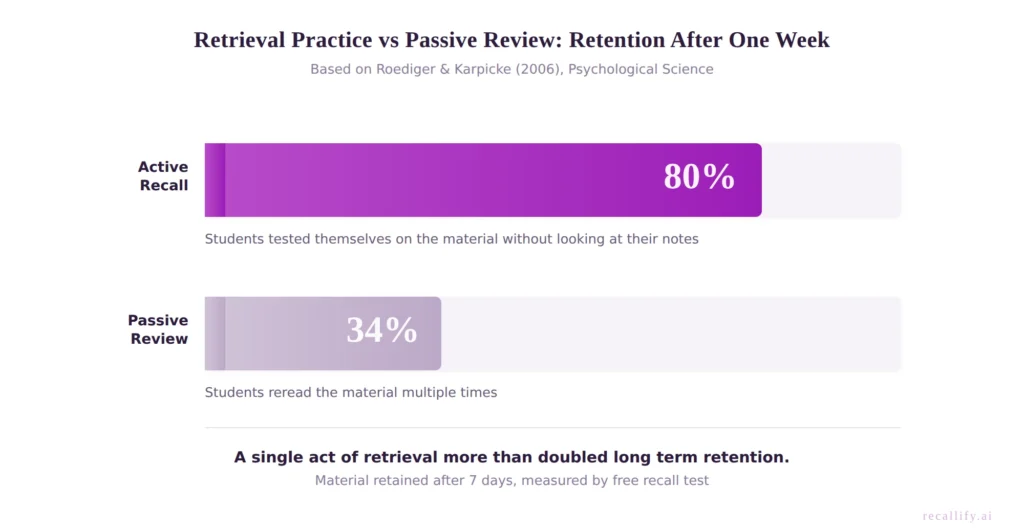
In one of the most cited studies on active recall, Roediger and Karpicke asked students to either reread a passage or take a recall test after studying it. After one week, the retrieval practice group retained approximately 80% of the material, compared to just 34% for the group that only reread. This study demonstrated that a single act of retrieval can more than double long term retention.
Reference: Roediger, H.L. & Karpicke, J.D. (2006). Test enhanced learning: Taking memory tests improves long term retention. Psychological Science, 17(3), 249–255.
Cepeda et al. (2008): Optimal Spacing Intervals
A large scale study by Cepeda and colleagues examined how the spacing of review sessions affects retention over different time horizons. They found that spacing out reviews over increasing intervals significantly improved long term retention compared to massed practice (cramming). Critically, the optimal spacing interval depended on how long the material needed to be retained, with longer retention goals benefiting from longer gaps between reviews.
Reference: Cepeda, N.J. et al. (2008). Spacing effects in learning: A temporal ridgeline of optimal retention. Psychological Science, 19(11), 1095–1102.
Karpicke and Blunt (2011): Retrieval Practice vs Concept Mapping
This study compared retrieval practice against concept mapping, a popular study technique often recommended by educators. Students who used retrieval practice produced 50% more correct responses on a subsequent test than those who created detailed concept maps. The finding was significant because concept mapping is considered an active learning technique, yet retrieval practice still outperformed it substantially.
Reference: Karpicke, J.D. & Blunt, J.R. (2011). Retrieval practice produces more learning than elaborative studying with concept mapping. Science, 331(6018), 772–775.
Dunlosky et al. (2013): Comparative Effectiveness of Study Techniques
A comprehensive review by Dunlosky and colleagues evaluated ten common learning techniques. Practice testing (active recall) and distributed practice (spaced repetition) were the only two techniques rated as having “high utility.” Popular methods such as highlighting, rereading, and summarisation were rated as having “low utility.” This review drew on hundreds of individual studies and remains one of the most authoritative assessments of learning technique effectiveness.
Reference: Dunlosky, J. et al. (2013). Improving students’ learning with effective learning techniques. Psychological Science in the Public Interest, 14(1), 4–58.
The Neural Pathway Evidence
Neuroimaging research has shown that retrieval practice activates different brain regions than passive review. When you actively recall information, the hippocampus and prefrontal cortex work together to reconstruct the memory, and this reconstruction process strengthens the neural connections involved. Repeated retrieval gradually shifts memories from hippocampal to neocortical storage, making them more stable and resistant to interference. This is consistent with the finding that active recall strengthens neural pathways in ways that passive review simply does not.
Active Recall and Cognitive Load
One of the less obvious benefits of combining active recall with spaced repetition is the reduction in cognitive load. Rather than trying to learn or review everything at once (which overwhelms working memory), spaced repetition breaks the process into smaller, focused sessions. Each session requires you to retrieve only a manageable amount of information, which keeps the cognitive demand within your brain’s natural capacity.
This matters especially for people who experience cognitive fatigue, whether from ADHD, neurological conditions, or simply the demands of a busy life. Short, spaced retrieval sessions are more sustainable than long, intensive study blocks and typically produce better results with less total time invested.
How to Use Active Recall and Spaced Repetition in Practice
These techniques are not limited to academic study. They can be applied to virtually any situation where you need to retain information over time.
For Students and Exam Preparation
After a lecture or study session, close your materials and write down everything you can remember. Then check what you missed and focus your next review on those gaps. Schedule follow up reviews at increasing intervals before your exam. Quiz generation tools can help automate the question creation process so you spend your time retrieving rather than preparing materials.
For Professional Development
Turn key takeaways from meetings, courses, or industry reading into questions. Review them periodically rather than filing notes away and never looking at them again. This is particularly effective for certifications, compliance training, or any role where you need to retain technical knowledge over time.
For Memory Support in Daily Life
Active recall is not just for formal learning. You can apply the same principle to personal information: appointments, conversations, instructions from a doctor, or details from a meeting. The act of trying to recall what was discussed, rather than simply rereading notes, strengthens your memory of it. For people managing memory challenges, combining retrieval practice with external memory aids can make a meaningful difference.
For Self Development
If you read widely or listen to podcasts, try summarising key insights from memory before moving on to new material. This simple habit converts passive consumption into active learning and significantly improves how much you retain over weeks and months.
Tools That Implement Active Recall and Spaced Repetition
Many apps and platforms now incorporate these techniques, from simple flashcard tools to more comprehensive systems.
Recallify takes a different approach to most flashcard apps. Rather than requiring you to manually create cards, it uses AI to generate recall questions automatically from your own content, whether that is a voice recording, a set of notes, or a PDF you have uploaded. It then schedules reviews using spaced repetition intervals based on proven retention curves, including the Ebbinghaus forgetting curve model. The app also adapts difficulty based on your performance, so you spend more time on material you find harder to recall.
Recallify was developed by Dr Sarah Rudebeck, a senior clinical neuropsychologist with a PhD in memory disorders from Oxford University, and is currently being evaluated in an NIHR funded feasibility study for cognitive support in brain injury self management. It is designed to work for students, professionals, and anyone who wants to retain more of what they learn, including people with ADHD, acquired brain injury, or other conditions that affect memory and attention.
iOS App
Get Recallify from the App Store to boost your memory, learning, and task management.

Android App
Get Recallify from Google Play to boost your memory, learning, and task management.

What is active recall and spaced repetition?
Active recall is a study technique where you test yourself on information by retrieving it from memory, rather than passively reviewing your notes. Spaced repetition is the practice of scheduling those reviews at increasing intervals over time. Together, they are the two most effective learning techniques identified by cognitive science research.
Does active recall actually improve memory?
Yes. Research consistently shows that retrieval practice (active recall) significantly improves long term retention. The landmark Roediger and Karpicke (2006) study found that students who practised recall retained 80% of material after a week, compared to 34% for those who reread. A comprehensive review by Dunlosky et al. (2013) rated practice testing as one of only two “high utility” learning techniques.
How effective is spaced repetition compared to cramming?
Substantially more effective for long term retention. Cepeda et al. (2008) demonstrated that spaced review intervals significantly outperform massed practice (cramming). While cramming can produce short term results for an exam the next day, spaced repetition produces durable memories that last weeks, months, or longer.
How does active recall reduce cognitive load?
By breaking learning into short retrieval sessions spread over time, active recall combined with spaced repetition keeps the demand on working memory within manageable limits. This is easier on the brain than long, intensive study sessions and is especially beneficial for people who experience cognitive fatigue.
Are there apps that use active recall and spaced repetition?
Yes. Many flashcard apps (such as Anki) implement spaced repetition algorithms. Recallify goes further by automatically generating recall questions from your own content (recordings, notes, PDFs) and scheduling reviews based on your individual performance, so you do not need to create cards manually.
Can active recall help with ADHD or memory conditions?
Active recall is useful for anyone, but it can be particularly helpful for people with ADHD, acquired brain injury, or other conditions that affect memory and attention. The structured, short session format suits fluctuating energy levels, and the technique provides a concrete strategy for retaining information that might otherwise be lost. See our pages on ADHD support and memory support for more on how these techniques apply.