
“Memory loss normal ageing” is often what we search for when a name escapes us, we forget why we walked into a room, or our keys turn up somewhere unexpected. Most everyday forgetting is a normal part of growing older: recall slows, but the underlying memory stays intact. Changes are worth checking when they are frequent, persistent and affect daily life. Normal ageing and more concerning changes can overlap, but learning the differences helps you decide whether to keep watching or ask a professional.

Memory loss normal ageing can cause
Some slowing of memory is an expected part of getting older. The brain does not keep new information quite as quickly as it did at twenty, and the speed of retrieval drops, so a fact that is firmly stored can still take longer to come back. The NHS puts it plainly: memory loss can simply be a natural part of getting older, and most people forget things from time to time. This common form of forgetting explains a great deal of what people worry about as they grow older.
Typical age-related change tends to come and go, with forgotten information returning later. The word arrives a few seconds later than you wanted, but it arrives. You forget why you came into the kitchen, then remember when you go back to where you started. You misplace your glasses, retrace your steps, and find them. You are slower to learn a new phone or a new colleague’s name, but you get there. In these cases, the underlying ability is intact; what has changed is the speed and the reliability of access, not the capacity itself. Day-to-day independence is not affected. You still manage your money, follow a recipe, hold a conversation, and find your way to familiar places.
Much ordinary forgetting is caused by things that have nothing to do with ageing of the brain. Poor sleep, stress, low mood, an underactive thyroid, certain medications, alcohol, and simply trying to hold too much in mind at once all degrade memory temporarily. These causes are common, often reversible, and easy to mistake for something more permanent.
Mild cognitive impairment, and how it differs
Mild cognitive impairment, usually shortened to MCI, falls between typical ageing and dementia. As the Alzheimer’s Society explains, some mental abilities such as memory and concentration become less reliable with age, which is normal; but when a person regularly has difficulty with mental tasks they used to do easily, and the problems continue for more than a few months, that can be a sign of MCI. The change is measurable on cognitive testing and is greater than would be expected for the person’s age. However, it does not yet stop the person from managing daily life independently. That last point is what separates MCI from dementia.
The distinction between memory loss normal ageing brings and MCI depends on a pattern, rather than one dramatic symptom. Changes in normal ageing are occasional, mild and stable over time. MCI is more frequent and noticeable to the person and often those around them. It tends to persist or slowly worsen rather than come and go. Forgetting starts to involve recent events and conversations more than old, well-rehearsed knowledge. Repeating a question within a short time, losing track of a familiar task or struggling with a plan you once handled easily are changes that move from “annoying” to “worth checking.”
MCI is described by the type of difficulty, not only by its severity. The change can affect memory most obviously, but it can also show up in attention, reasoning, language, or the drive to get started on things. Two people with MCI may therefore look quite different from one another, which is part of why a single self-administered test cannot settle the question. A clinician looks at the whole picture: the kind of difficulty, how long it has been present, whether it is getting worse, and whether anything reversible could be driving it.
MCI is not dementia. For some people it is an early sign of a condition that later causes dementia. For others it stays stable or improves, particularly when a reversible cause is found and addressed. A diagnosis calls for investigation and support; it does not mean dementia is inevitable.
Signs that warrant a closer look at mild cognitive impairment
A pattern of changes that persist tells clinicians more than a single moment of forgetting. Knowing the patterns clinicians take seriously helps you describe changes if you seek advice, though it cannot help you diagnose yourself. When people weigh up whether a change is age-related memory change or something more, it is usually this kind of pattern, rather than any one lapse, that tips the balance toward seeking advice.
- Asking the same question or telling the same story repeatedly within a short period, without realising it.
- Forgetting recent conversations or events while older memories stay clear.
- Increasing difficulty following or finishing a familiar multi-step task, such as cooking a known recipe or paying the usual bills.
- Getting lost or disoriented in places that used to be familiar.
- Relying much more heavily on notes, reminders, or other people to keep track of ordinary things, where you previously did not.
- Other people, rather than only you, beginning to notice and comment on the changes.
These signs persist or worsen, unlike the memory loss normal ageing causes. If a change has been present for several months, is happening often, is being noticed by others, or is starting to affect the things you need to do each day, it is worth checking with a doctor.
When to see a doctor about memory
The NHS advises you to see a GP if memory problems are affecting your day-to-day life. It is often nothing serious, but it is best to get checked, partly because some causes are treatable and any help you might need tends to work better when it is started early. The same guidance says: do not try to self-diagnose the cause of memory loss; always see a GP.
It is also reasonable to seek advice sooner if the changes are happening quickly, if other people are clearly more worried than you are, or if there are other symptoms alongside the memory change, such as confusion, personality shifts, or difficulty with words. A GP can check for the common reversible causes, take a careful history, and refer on to a memory clinic for assessment if that is warranted. Going early costs little and is often quietly reassuring, because a large share of memory worries turn out to be memory loss normal ageing explains, or another cause that is manageable.
Where Recallify fits while you work things out
We built Recallify because people noticing memory changes had tools that were either clinical and intimidating or generic and poorly suited to their needs. Recallify is an everyday cognitive support app made by clinical neuropsychologists, including our co-founder Dr Sarah Rudebeck, a Senior Clinical Neuropsychologist with a PhD in memory and amnesia from Oxford. It is not a test and it cannot tell you whether what you are noticing is typical ageing or something that deserves assessment. It can make the period before assessment easier to manage and help you describe changes accurately to a professional.
You can capture conversations, appointments, and the things you want to hold on to as voice notes that are transcribed and summarised. This takes less effort than remembering alone, and you keep the record. Gentle reminders arrive without you having to remember them. Over time, the notes you build also give you and a clinician a more accurate picture than memory alone of what has been changing. For the background, our overview of how long-term memory works explains the mechanism in accessible terms, and our guide to everyday memory support sets out how the app fits into daily routines. If you would like a structured place to begin reflecting on what you are noticing, our collection of self-assessments offers a calmer starting point than searching symptoms alone.
Keeping the worry proportionate
When you are anxious, grading yourself against a checklist is less useful than paying attention to changes over time. Watching the pattern helps you distinguish memory loss normal ageing causes from the kind that signals MCI. Occasional, mild, self-correcting forgetting that leaves your independence intact is, for most people, an ordinary part of growing older. Frequent, persistent, worsening changes that others notice and that start to affect daily life are the ones to bring to a doctor. Knowing the difference does not remove the worry entirely, but it helps you decide whether to book a GP appointment that is far more likely to reassure than to alarm. For the fuller picture of what a diagnosis can mean and how to live well alongside it, our detailed guide to MCI takes the subject further than this explainer can.
Recallify is designed as an everyday support tool and is not a medical device. It does not provide diagnosis or clinical decision support, and is intended to complement, not replace, professional medical care.
iOS App
Get Recallify from the App Store to boost your memory, learning, and task management.

Android App
Get Recallify from Google Play to boost your memory, learning, and task management.

Web App
Get Recallify in your browser to boost your memory, learning, and task management.

Memory and learning
Building a Spaced Repetition Routine That Sticks

Education and study
Active Recall and Cognitive Load: How to Study Without Burning Out
Memory and learning
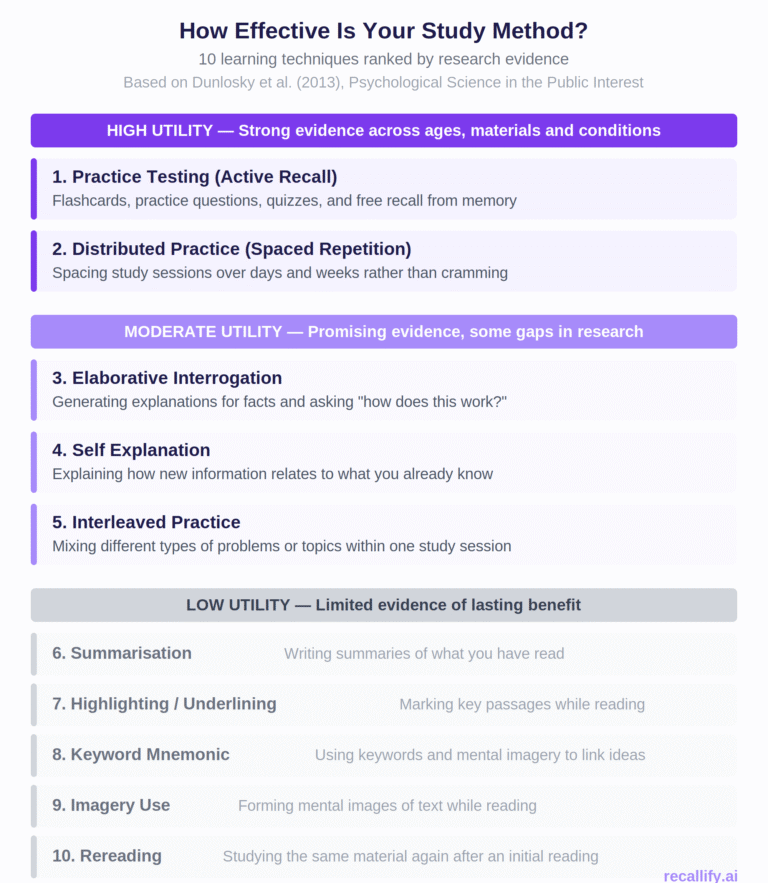
The Evidence for Active Recall and Spaced Repetition: What Research Actually Shows