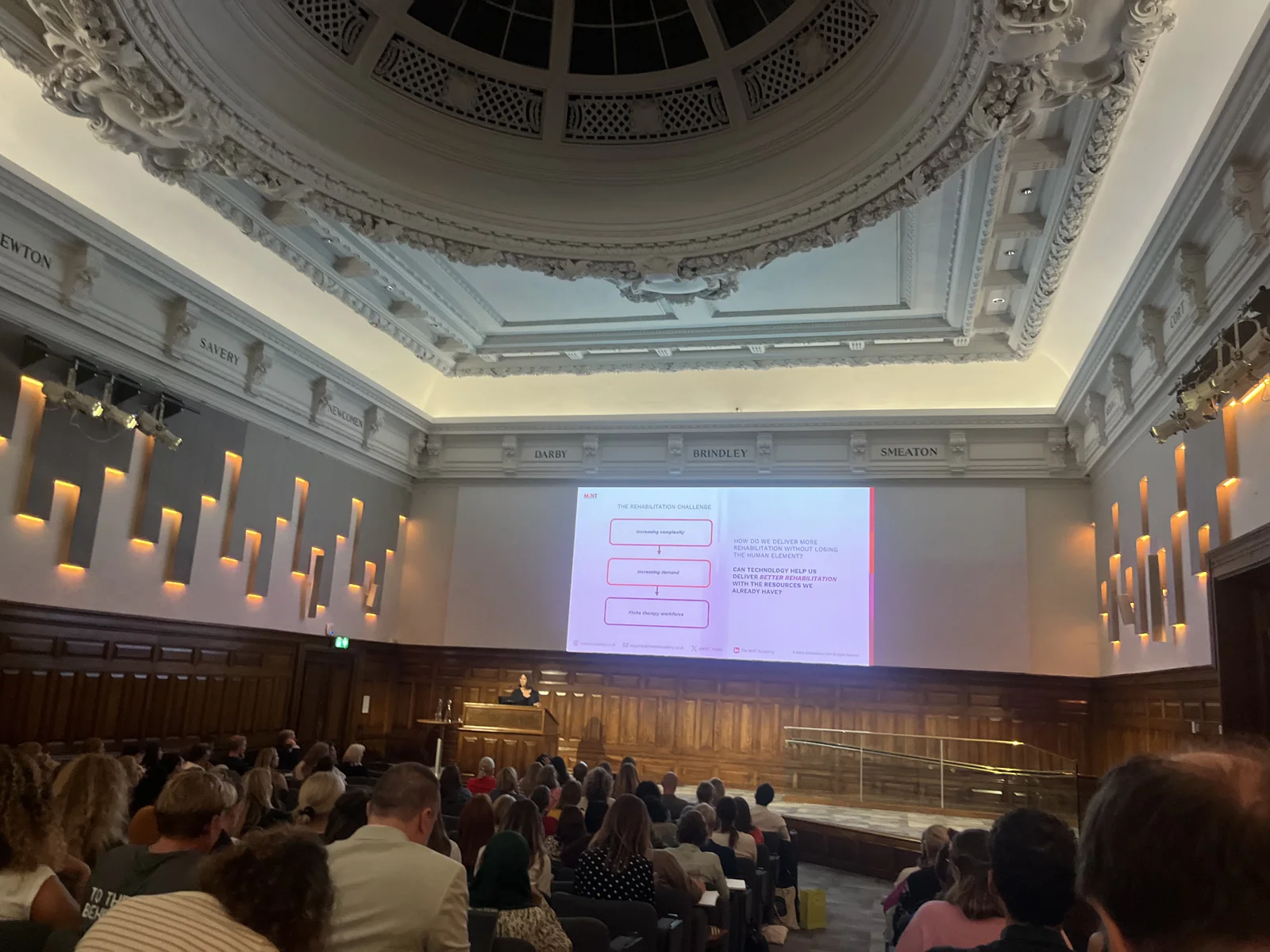
Charlie Roberts, Research Associate at Recallify, attended the BIS Services conference Human-Centred AI: Innovation, Safeguarding and Risk in Neurorehabilitation, held on 17 September 2026 in the stunning surroundings of One Great George Street in London. The day brought together clinicians, case managers, researchers and AI users to ask one big question: how do we use AI to safely support people in rehabilitation without losing the human element?
Conference report by Dr Charlie Roberts, Research Associate at Recallify.
There were plenty of answers, a few warnings and lots to think about. Here is what Charlie heard, what stayed with us and how it shapes the way we build Recallify.
A packed programme of human-centred AI in rehabilitation
The day opened with a welcome from Dr Neil Parrett, owner of NPsych, followed by an introduction from conference chair Rhiannon Seaford-Jones of Stokes Case Management.
Getting to grips with AI: Rebecca Whitney
Rebecca set the scene with a clear overview of what AI is and how it differs between platforms. She cleared up some common misconceptions and walked through the red flags and risks to look out for. Her strongest message: rather than closing the door on AI, professionals need to step in and learn about it or in Rebecca’s words “take flight”
AI in cognitive rehabilitation and operations: Natalie McKenzie
Natalie, founder and director of BIS Services, shared practical examples of how she has used AI to make better use of staff time. The point was never to replace clinicians. It was to free them up to spend more time face to face with the people they support.
At the first coffee break, the exhibition stands were buzzing, with plenty of interesting people to talk to and some great giveaways.
The good, the bad and the unknown: Linda Sayers
Linda, of Linda Sayers Social Care Consultancy, shared real-life examples of the risks AI poses for both children and adults. These included court cases where people had relied on information from chatbots, with serious consequences. She also shared a quote that stayed with us: AI cannot see the nuances that humans can. expressions, body language, the things left unsaid. Real food for thought.
AI and mental capacity: Dr Martine Stoffels
Dr Stoffels of Nexus ABI looked at AI in the context of mental capacity assessments. Clients may increasingly use or rely on AI, and tools such as smart glasses could help someone answer questions and perform well cognitively in an assessment. Their day-to-day reality may be very different. Assessors need to distinguish between a person's own ability and what has been shaped by AI. She also highlighted the importance of knowing the whole history of a person as AI can mask parts of someone's history. so gathering the full picture matters more than ever.
Dr Stoffels shared that AI compensates for some executive deficits, but not all. It may often help with planning, prospective memory and working memory. Its help is limited or uncertain for self-monitoring and anosognosia and for suggestibility it may even make things worse.
Lunch and networking gave everyone a chance to catch up. A delicious lunch gave everyone the chance to catch up and share reactions to the morning's talks.
AI in paediatric neurorehabilitation: Dr Penny Trayner
After a delicious lunch, Dr Penny Trayner of Clinical Neuropsychology Services Ltd spoke about the opportunities and risks of AI for children. Her message was balanced: AI is not inherently dangerous, but like any technology it needs careful monitoring. Penny has developed a framework for AI use, and her key takeaways were:
AI is not inherently harmful. Unsupervised or poorly designed use poses real risk to still-developing brains.
Displacement is the core concern. AI can crowd out play, human connection, struggle, sleep and physical activity.
Cognitive risks are real. Over-reliance, weakened metacognition and reduced critical thinking are emerging concerns.
Social and emotional development requires human interaction. AI companions cannot replicate the value of peer relationships and real-world experience.
Clinicians must monitor, not just observe. Ask whether underlying capacities are growing or being bypassed by AI.
Practical safeguarding: Jeff Goodright
Jeff, director of Cyber Spider, brought a different perspective on the practical safeguarding side of AI. He spoke about unregulated advice from chatbots and how AI can influence decision making and increase vulnerability.
The afternoon break brought tiered stands piled high with scones, topped with cream and fresh strawberries. A very British way to refuel and to carry on the conversations from the sessions.
The future of neurotech: Laura Marriott
Later in the afternoon, Laura Marriott, a specialist occupational therapist from The MINT Academy, spoke about the future of neurotechnology. She explored how AI can be used with different client groups, the challenges and benefits it brings, and real-world examples such as driving simulators in rehabilitation.
Her framing of the rehabilitation challenge. increasing complexity, increasing demand, a finite therapy workforce. asked the question at the heart of the whole day: can technology help us deliver better rehabilitation?
Themes that stayed with us
Across the talks, the coffee breaks and the networking, a few themes came up again and again.
Over-reliance is the biggest worry. Many conversations on the day centred on people with executive functioning difficulties coming to rely on AI for everything. That could erode communication and interpersonal skills over time. AI works best as a compensatory strategy, not as a replacement for human interaction.
Chatbots give unregulated advice. General-purpose chatbots will answer almost any question, with no clinical oversight. The court cases Linda described showed what can happen when people act on that advice.
AI can be too agreeable. Speakers throughout the day noted that chatbots can validate a user’s assumptions rather than challenge them. For someone whose difficulties make them vulnerable or suggestible, an assistant that repeatedly says they are right can be hard to navigate.
Hallucinations are hard to spot. AI can invent facts with total confidence. Checking against reliable sources can help, but difficulties with critical thinking or self-monitoring can make errors harder to notice.
Attachment is a real risk. AI companions can feel like relationships, but they cannot replace the value of real people, especially for children and young people still developing socially.
Data protection matters. Health and memory information is among the most sensitive data a person can share. Knowing where it goes, who can see it and how it is used under UK GDPR should be part of choosing any AI tool.
For teams considering AI, these questions also apply at an organisational level: who is accountable, what data will be used, and do staff understand the limitations? Sesen AI’s AI readiness assessment offers a short self-assessment covering governance, data, skills and risk.
Recallify’s approach to these risks
Many of the concerns raised on the day are ones we have thought hard about while building Recallify.
Designed with clinical experience. Recallify was co-founded by Dr Sarah Rudebeck, a clinical neuropsychologist, and grew out of her clinical work with people. Every feature starts with a clinical question: will this support someone's everyday life and could it cause harm?
No chatbot. Recallify has no chatbot or AI companion. There is no character to chat with, so it does not offer a simulated relationship or an endless stream of agreeable conversation.
Bounded AI that only searches your own memories. You can still ask Recallify a question, but its AI is bounded to the information you have put into the app. It cannot search the web, so asking "What's the weather like tomorrow?" won't get you an answer. Asking "What day did the doctor say my prescription will be ready?" can help you find information in your own recorded memories, if you saved it.
That boundary matters. Answers come from what you recorded, rather than the open internet. This keeps the search grounded in your own life, but AI can still make mistakes. Check important answers against the original recording or note, and confirm medical instructions with your clinician. And Recallify is designed as a compensatory tool: it helps people remember conversations and appointments so they can take part in them fully, rather than replacing the human interactions themselves.
Human support comes first. A theme throughout the day was that AI works best with people alongside it, not instead of them. That applies to Recallify too. Our team offers users real, human support with Recallify, from downloading the app to getting set up and building it into everyday routines. Many of our users are supported by a family member, carer or clinician, and we work with them as well, so the app fits around the person and their goals rather than the other way round.
Final thoughts
The message of the day was clear: AI is neither a cure-all nor something to fear. Used thoughtfully, with clinicians monitoring rather than just observing, it can free up time, extend therapy and support independence. Used carelessly, it can displace the very skills and relationships rehabilitation is meant to build.
Above all, the day was a reminder that rehabilitation is, and always will be, about people. Recognising a facial expression, noticing a hesitation or sharing a laugh over a scone are parts of the human connection that technology should not displace. The relationships between clients, families and clinicians are where real progress happens. The best technology should protect and make room for those human connections, giving people the confidence and independence to take part in them, never standing in for them.
Thank you to BIS Services for organising such a thoughtful day, and to all the speakers and attendees for the conversations that followed.
Recallify is free to download and trial on iOS and Android. If you try it and have thoughts, the team would love to hear from you. Get in touch at info@recallify.ai.
For wider guidance on rehabilitation following brain injury, see Headway’s rehabilitation and continuing care information.
Recallify is designed as an everyday support tool and is not a medical device. It does not provide diagnosis or clinical decision support, and is intended to complement, not replace, professional medical care.
iOS App
Get Recallify from the App Store to boost your memory, learning, and task management.

Android App
Get Recallify from Google Play to boost your memory, learning, and task management.

Web App
Get Recallify in your browser to boost your memory, learning, and task management.